

amrit Sanchar
Khande Di PahulThe Sikh Initiation Ceremony
introduction
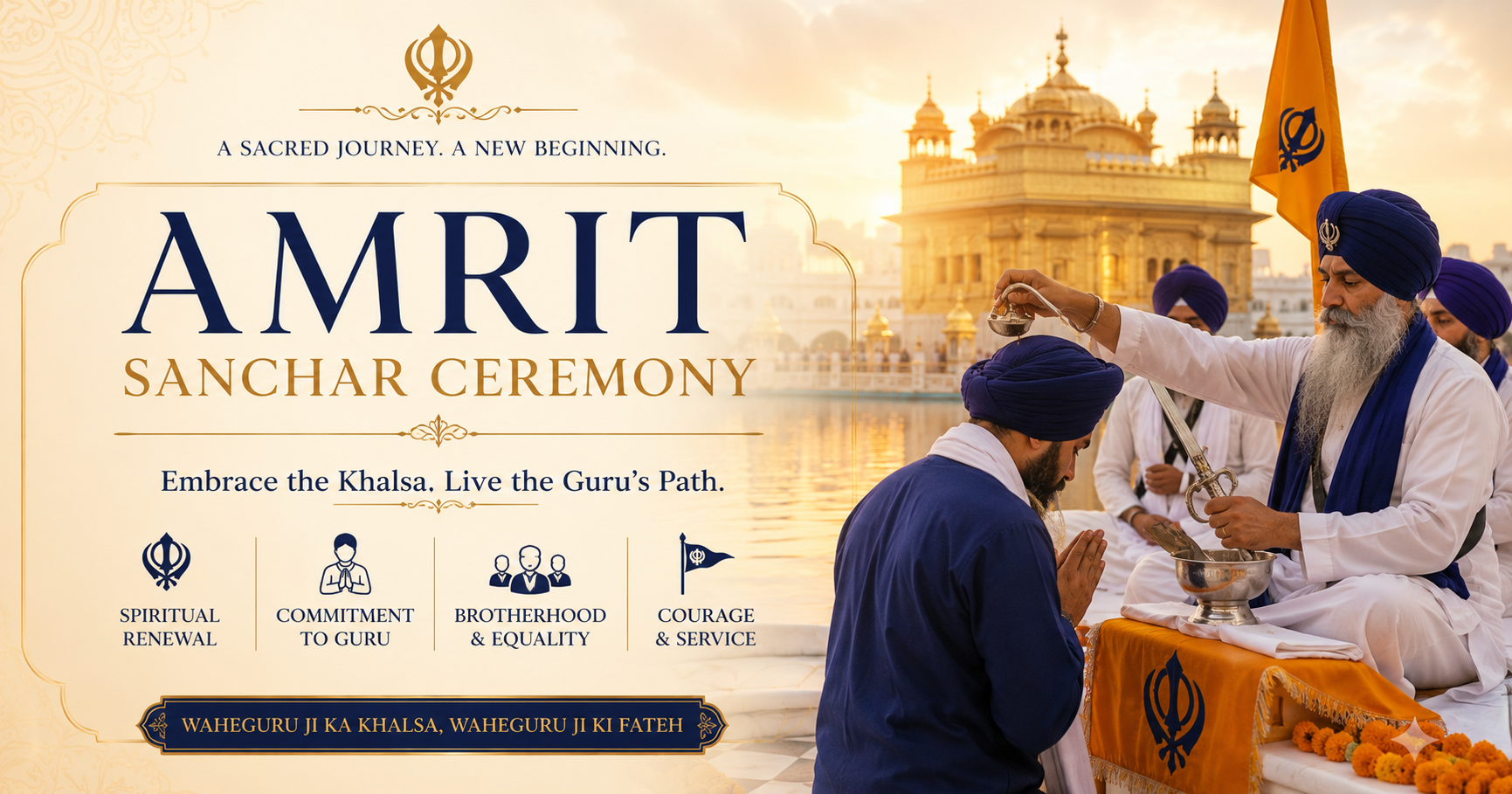
Amrit Sanchar — also known as Khande Di Pahul — is the Sikh ceremony of initiation and baptism. Guru Gobind Singh Ji introduced it when he founded the Khalsa in 1699. Five baptised Sikhs, known as the Panj Pyare, conduct the ceremony in any place sanctified by the presence of the Guru Granth Sahib — preferably a Gurdwara. All five must observe Sikh religious discipline and live according to the Sikh code of conduct.
A Sikh who joins the Khalsa through Amrit Sanchar takes the title Singh (for males) or Kaur (for females) and is commonly known as Amritdhari. Notably, a Sikh may undergo this initiation at any age.
The Historical Account
“The Guru caused his five faithful Sikhs to stand up. He placed pure water into an iron vessel and stirred it with a Khanda — a double-edged sword. He then recited over it the sacred verses appointed for the ceremony: the Japji, the Jaap, Guru Amar Das’s Anand, and certain Swaiyas of his own composition.”
Where the Ceremony Takes Place
The ceremony takes place in any quiet and convenient location. In addition to the Guru Granth Sahib, six Sikhs must be present: one Granthi to read from the holy scripture, and five representing the original Panj Pyare to administer the initiation.
Both those receiving and those administering the initiation must wash their hair before the ceremony begins.
Who Can Administer Amrit
Any mentally and physically sound Sikh — male or female — may administer the rites of initiation. However, they must themselves have already received Amrit, continue to follow the Sikh Rehni (Way of Life), and wear all five Articles of Faith — the Five Ks.
Requirements for Those Being Initiated
Amrit Chhakhna refers to the drinking of the Amrit or the Nectar. The Amrit is administered in the presence of the holy text of the Sikhs, the Guru Granth Sahib, which is consideded the living Guru.
The candidates take a full bath, wear the five 5 Kakas and present themselves before the Guru Granth Sahib for initiation of Amrit.The five Sikhs chosen to prepare and administer the Amrit represent the original Panj Pyare. Each must have led a virtuous life and strictly observed Sikh discipline.Before the ceremony begins, the Panj Pyare explain the Amrit conditions to the candidates. They describe the pure and virtuous life each candidate must commit to leading. When the candidates agree to live by the discipline and code of Sikh conduct, the Panj Pyares start preparing the Amrit.
Additionally, the candidate must carry no token of any other faith, must not have a bare head or wear a cap, and must not wear any body piercings or ornaments. Throughout the ceremony, those receiving initiation stand respectfully with hands folded, facing the Guru Granth Sahib.
During the Ceremony
During the ceremony, one of the five Panj Pyare stands and explains the rules and obligations of the Khalsa Panth. Those receiving initiation confirm their willingness to abide by these rules.
A Sarb Loh (Iron or steel) cauldron (Bata or bowl) is filled with clean water. Some Patashas (sugar crystals/plums) are poured into the water. The Five Beloveds then sit in Vir Asan ( seated on the ground with left knee down and the right knee up) around the cauldron.
One of the Panj Pyare stirs the Amrit with a Khanda while all five recite the five sacred Banis: Japji Sahib, Jaap Sahib, Sawayae, Chaupai Sahib and Anand Sahib. They recite from the Guru Granth Sahib and Dasam Granth with full concentration on the Amrit preparation.The solution thus prepared is called Amrit (nectar of immortality).
The various ingredients and the aids to the preparation of this Holy Nectar are symbolic of a few things that are held in the highest regards by the Khalsa. The “Sarb Loh Bata” (Iron cauldron) signifies the strength of heart and mind. The chanting of hymns signify strong faith and cohesion in the devotees. The Khanda (the two-edged sword) signifies a spirit of valor and bravery.
In this religion, it is believed that it should not be taken into mind that Amrit Chhakhna is the end purpose. It is the start of one’s journey on a right path to attain a pure and pious life which is essential to attain God (according to the Guru Granth Sahib. It is not something external.
Is Amrit Chhakhna (Baptism) Essential for a Sikh?
This is one of the most commonly asked questions about the Sikh faith. According to the Sikh Rehat Maryada, taking Amrit is the ideal and complete form of Sikh commitment — it represents a full and formal acceptance of the Khalsa way of life as Guru Gobind Singh Ji established it in 1699.
However, Sikhism also recognises that a person’s spiritual journey is personal and continuous. A Sikh who has not yet taken Amrit is not considered lesser in the eyes of God. The Guru Granth Sahib teaches that God values sincere devotion, honest living and service to others above outward symbols alone.
In practice, Sikhs are generally recognised in three categories:
- Amritdhari — a baptised Sikh who has taken Amrit and fully observes all five Panj Kakars and the Sikh Rehat Maryada
- Keshdhari — a Sikh who keeps uncut hair (Kesh) and follows Sikh practices but has not yet formally taken Amrit
- Sahajdhari — a Sikh who is on the path of Sikhism, believes in its teachings, but does not yet keep uncut hair
- The Sikh Rehat Maryada encourages every Sikh to aspire to take Amrit when spiritually ready. It is not a ceremony to be entered into lightly — it is a lifelong commitment to the discipline and values of the Khalsa. Furthermore, there is no upper age limit — Sikhs can take Amrit at any stage of life when they feel truly prepared.
Ultimately, Amrit Sanchar is not the end of a Sikh’s journey — it is the beginning of a new and deeper commitment to living according to Gurbani, serving the Sangat and walking in the footsteps of the Panj Pyare.
