

INTRODUCTION TO SIKHISM
Core Beliefs, Principles & Way of LifeWhat is sikhism
A way of life and philosophy well ahead of its time when it was founded over 500 years ago, the Sikh religion today has a following of over 20 million people worldwide. Sikhism preaches a message of devotion and remembrance of God at all times, truthful living, equality of mankind, and social justice. It denounces superstitions and blind rituals and is open to all through the teachings of its 10 Gurus enshrined in the Sikh Holy Book and Living Guru, Sri Guru Granth Sahib.
The word ‘Sikh’ in the Punjabi language means ‘disciple’, Sikhs are the disciples of God who follow the writings and teachings of the Ten Sikh Gurus. The wisdom of these teachings in Sri Guru Granth Sahib are practical and universal in their appeal to all mankind.
“I observe neither Hindu fasting nor the ritual of the Muslim Ramadan month; Him I serve who at the last shall save. The Lord of universe of the Hindus, Gosain and Allah to me are one; From Hindus and Muslims have I broken free. I perform neither Kaaba pilgrimage nor at bathing spots worship; One sole Lord I serve, and no other. I perform neither the Hindu worship nor the Muslim prayer; To the Sole Formless Lord in my heart I bow. We neither are Hindus nor Muslims; Our body and life belong to the One Supreme Being who alone is both Ram and Allah for us.”
– (Guru Arjan Dev, Guru Granth Sahib, Raga Bhairon pg. 1136)
“Any human being who faithfully believes in: (i) One Immortal Being, (ii) Ten Gurus, from Guru Nanak Dev to Guru Gobind Singh, (iii) The Guru Granth Sahib, (iv) The utterances and teachings of the ten Gurus and, (v) the baptism bequeathed by the tenth Guru, and who does not owe allegiance to any other religion is a Sikh.”
– (Reht Maryada, Sikh Code of Conduct)
THE RELATIONSHIP WITH GOD
Sikh spirituality centres on this need to understand and experience God, and eventually become one with God.
To achieve this, a person must shift their attention away from themselves and toward God. This state — called mukti (liberation) — comes through the grace of God alone. In other words, God grants it to human beings rather than human beings earning it themselves. However, God guides people toward this grace through holy books and through the living examples of saints.
“Truth is the highest of all virtues, but higher still is truthful living.”
Sikhs believe that God can’t be understood properly by human beings, but he can be experienced through love, worship, and contemplation. They look for God both inside themselves and in the world around them to help themselves achieve liberation and union with God.
When a Sikh seeks God, they look both at the created world and deep into their own heart and soul. Their aim is to recognise the divine order God has woven into everything — and through that recognition, to understand God’s nature. Most human beings struggle to see this true reality because their own self-centred pride (haumain) and attachment to physical things cloud their vision. Nevertheless, Sikhs believe that God dwells inside every person, no matter how flawed they may appear, which means everyone is capable of change.
“Just as fragrance is in the flower, and reflection is in the mirror, in just the same way, God is within you.”
GOD BEYOND OURSELVES
Sikhs believe that God’s message can be found in several ways outside ourselves.
- The message is written in the whole of creation; look at it with open eyes and see the truth of God, for creation is the visible message of God
- Sikhs believe that most of us misunderstand the universe. We think that it exists on its own, when it really exists because God wills it to exist, and is a portrait of God’s own nature
- The message has been shown to us by the Gurus in their lives and in their words
- The message is set down in the teachings of scripture
How Sikhs Experience God in Daily Life
Sikhs build their lives around their relationship with God and their place within the Sikh community. The Sikh ideal unites action with belief — to live a good life, a person must both do good deeds and meditate on God. Importantly, Sikhism does not ask people to retreat from ordinary life in order to draw closer to God. Instead, it asks them to use ordinary life as the very path toward God. Consequently, the three core duties every Sikh must fulfil can be summed up in three words: Pray, Work, Give.
THE THREE PILLARS OF SIKHISM

naam japna
The Gurus directed Sikhs to practise Simran and Naam Japna — meditation on God through reciting, chanting, singing and constant remembrance, followed by deep study and reflection on God’s Name and virtues (Gurbani: the compendium of eternal truth). Listen to Gurbani. As a result, the Sikh’s inner voice stays immersed in praise and appreciation of the Creator — the one eternal God, Waheguru — and in surrender to His will. Throughout every breath of life, the Sikh strives to remain intuitively focused on the True Path.

KIRAT KARNI
The Gurus called on Sikhs to live as honourable householders and practise Kirat Karni — to earn an honest living through physical and mental effort, while accepting both pain and pleasure as God's gifts and blessings. Additionally, a Sikh must remain truthful at all times, fear none but the Eternal Soul, and build a life of decency grounded in Dharam — a life governed by spiritual, moral and social values.
VAND CHAKNA
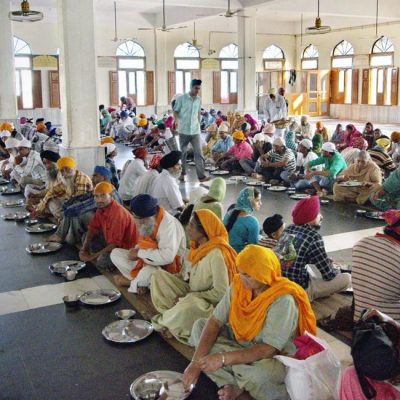
The Gurus called on Sikhs to share their wealth within the community by practising Vand Chakna — “Share and Consume Together”. Langar. The community, or Sadh Sangat, forms a vital part of Sikh life. Furthermore, every Sikh must actively participate in a community that pursues the values set out by the Sikh Gurus, contributing in whatever way they can to the common pool. This spirit of sharing and giving remains one of the most enduring messages of Guru Nanak
Origin of Sikhism
Sikhism was founded in 15th century Punjab by Guru Nanak Dev Ji - explore the full history.
Read More →Ten Gurus
Meet the ten Gurus who shaped Sikhism from 1469 to 1708 - their lives and teachings.
Read More →Guru Granth Sahib
The eternal living Guru - 1,430 pages of sacred scripture, the spiritual authority of all Sikhs.
Read More →