

GURUDWARA
The Sikh Place Of Worship“The Gateway Through Which the Guru Can Be Reached”
Quick facts
| Name meaning | Gur (Guru) + Dwara (Gateway) — “The gateway through which the Guru can be reached” |
| First Gurudwara | Built in Kartarpur, on the banks of the Ravi River, Punjab — by Guru Nanak Dev Ji in 1521 |
| Original name | Dharamsala — used during the time of the early Gurus |
| Name introduced by | Guru Hargobind, the sixth Sikh Guru |
| Religious status given by | The presence of the Guru Granth Sahib (Holy Book) inside |
| Open to | Anyone of any faith — all are welcome at all times |
| Managed by | A committee of the local Sikh community |
| No. of entrances | Four doors — one on each side, open to all |
WHAT IS A GURUDWARA
Any place where the Guru Granth Sahib is installed and treated with due respect can be referred to as a Gurdwara. During the times of the early Gurus, Sikh places of worship were referred to as dharamsalas. They were a place where Sikhs could gather to hear the Guru speak or sing hymns in the praise of Waheguru. As the Sikh population continued to grow, Guru Hargobind, the sixth Sikh guru, introduced the word ‘gurdwara’. The first gurdwara was built in Kartarpur, on the banks of Ravi River in the Punjab region by the first Sikh guru, Guru Nanak Dev Ji in the year 1521. The etymology of the term ‘Gurdwara’ is from the words ‘gur (a reference to the Sikh Gurus) and ‘dwara (gateway in Gurmukhi), together meaning ‘the gateway through which the guru could be reached’.Thereafter, all Sikh places of worship came to be known as gurdwaras. In Gurdwara, the Guru is not a person but the book of Sikh scriptures called the Guru Granth Sahib (Holy Book). It is the presence of the Guru Granth Sahib that gives the Gurdwara its religious status, so any building containing the Holy Book is a Gurdwara.
THE PURPOSE OF A GURDWARA
- It’s a place to learn spiritual wisdom
- It’s a place for religious ceremonies
- It’s a place where children learn the Sikh faith, ethics, customs traditions and texts
- A Gurdwara is also a community centre, and offers food, shelter, and companionship to those who need it.
Gurdwaras are managed by a committee of their community.
INSIDE THE GURDWARA
There are no idols, statues, or religious pictures in a Gurdwara, because Sikhs worship only God, and they regard God as having no physical form. Nor are there candles, incense, or bells, or any other ritualistic devices.
The focus of attention, and the only object of reverence in the main hall (or Darbar Sahib) is the book of Sikh scripture, the Guru Granth Sahib, which is treated with the respect that would be given to a human Guru.
The Guru Granth Sahib is kept in a room of its own during the night and carried in procession to the main hall at the start of the day’s worship.
The book is placed on a raised platform (Takht or Manji Sahib, meaning “throne”) under a canopy (Chanani or Palki), and covered with an expensive cloth when not being read.
During a service a person with a whisk or fan called a Chaur waves it over the Guru Granth Sahib.
Although Sikhs show reverence to the Guru Granth Sahib, their reverence is to its spiritual content (shabad) not the book itself. The book is just the visible manifestation of the shabad.
THE FOUR DOORS
There are four doors into a Gurudwara — one on each side of the building. They are a powerful symbol that people from all four points of the compass are welcome, and that members of all castes are equally welcome. There is always a light on inside a Gurudwara, to show that the Guru’s Light is always visible and accessible to everyone at any time.
Door of Peace
A place of rest and spiritual calm, open to all who seek refuge.
Door of Livelihood
Honouring honest work and the dignity of earning a living.
Door of Learning
A place of education — spiritual, ethical and scriptural.
Door of Grace
God’s grace is freely available to all who enter with humility.
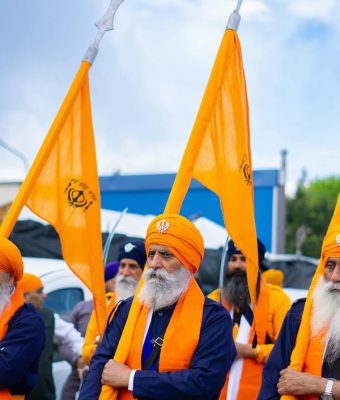
Nishan sahib
The Nishan Sahib is a Sikh triangular flag made of cotton or silk cloth, with a tassel at its end. The word, Nishan Sahib means exalted ensign, and the flag is hoisted on a tall flagpole, outside most Gurdwaras. The flagpole itself, covered with fabric, ends with a two-edged dagger (khanda) on top. The emblem on the flag is also known as Khanda, which depicts a double-edged sword called a khanda in the centre, a chakkar which is circular, and flanked by two single-edged swords, or kirpans.In the centre of the insignia is the two-edged sword which symbolises the Creative Power of God that controls the destiny of the whole universe. It is the Sovereign Power over life and death. One edge of the Sword symbolises divine justice, which chastises and punishes the wicked oppressors; the other edge symbolises Freedom, and Authority governed by moral and spiritual values.

khanda
| Double-edged sword (Khanda) | Represents the Creative Power of God that controls the destiny of the universe. One edge = divine justice; the other = freedom governed by moral values. |
| Chakra (Circle) | Symbol of the all-embracing Divine Manifestation — without beginning or end, timeless and Absolute. A symbol of oneness, justice, humanity and immortality. |
| Sword of Piri (left) | The Sword of Spiritual Sovereignty — representing the Guru’s spiritual authority. |
| Sword of Miri (right) | The Sword of Political Sovereignty — representing temporal power. Both Piri and Miri must always be in balance. |
VISITING A GURDWARA
In India many Sikhs visit a Gurdwara before work. In Britain 39% of Sikhs go once a week, and while Sikhs do not regard any particular day of the week as a holy day, they usually go to a Gurdwara on Sundays as that fits the UK pattern of work.
Most Sikhs go to the Gurdwara on Gurpurbs, the festivals honouring the Gurus.
Anyone, of any faith, can visit a Gurdwara and will be made welcome.
BEFORE GOING INTO A GURDWARA
All visitors to the Gurdwara should remove remove their shoes and cover their heads before entering the main hall. It is forbidden to smoke or take tobacco on to the premises and visitors cannot enter the Gurdwara while under the influence of alcohol or drugs.
ON ENTERING A GURDWARA
Sikhs will bow to the Guru Granth Sahib as the first thing they do, touching the floor with their forehead. This not only shows their respect but also indicates that they submit themselves to the truths contained in the book. People also place an offering of food or money in front of the Guru Granth Sahib. This is used to run the Gurdwara and the free food kitchen (Langar). The offering is not charity but a sharing of God’s gifts. If a person has no money or food to offer they may offer flowers, or just some words of sincere thanks. After bowing to the Guru Granth Sahib a Sikh will greet the congregation in a low, quiet voice with the words:
Waheguru Jee Ka Khalsa,
Sri Waheguru Jee Kee Fateh.
The Khalsa owes allegiance to God,
sovereignty belongs to God alone
SEATING IN A GURDWARA
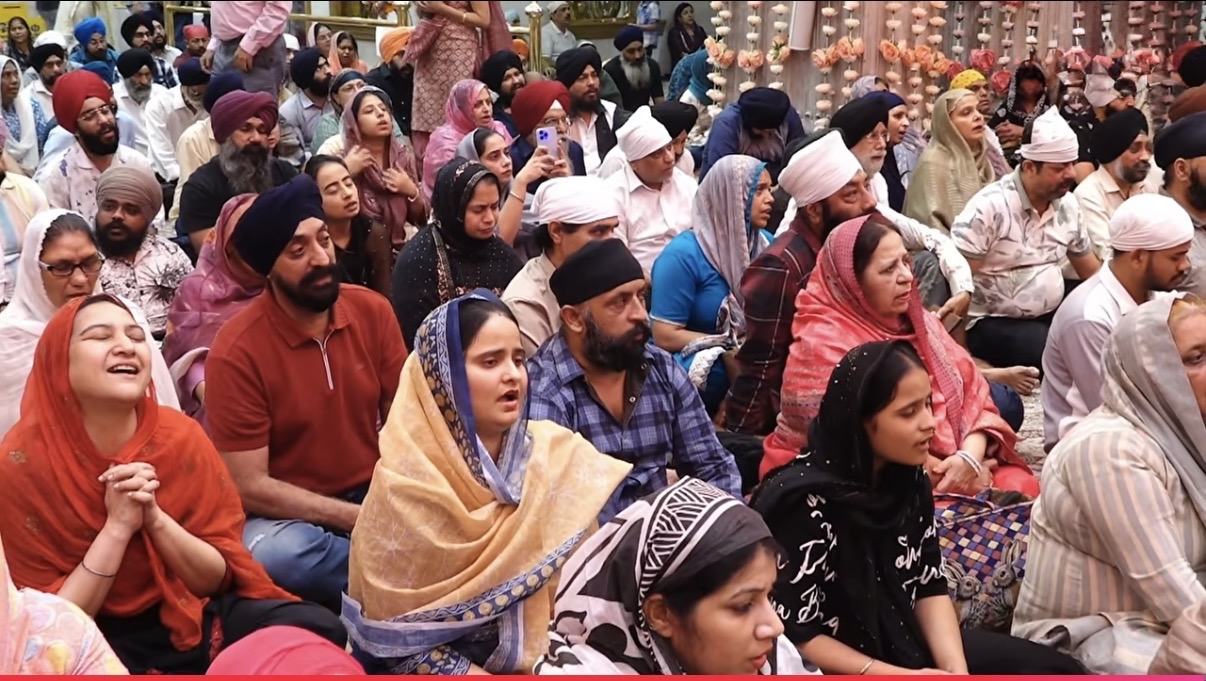
Everyone sits on the floor in a Gurdwara. This is to be humble before the Guru Granth Sahib and because it gives everyone a place of equal status to sit. Most people sit cross-legged. Cushions and seats are not allowed.
No-one should sit with their feet pointing at the Guru Granth Sahib. Anyone who walks round the Guru Granth Sahib or the Gurdwara must do so in a clockwise direction.
Men and women generally sit on separate sides of the hall
SACRED FOOD IN THE GURDWARA
Towards the end of a service karah prasad, a sweet vegetarian food that has been blessed, will be served. This should be taken and received in cupped hands as a gift of God
A GURDWARA SERVICE
Sikhs do not have ordained priests and any Sikh can lead the prayers and recite the scriptures to the congregation.Each Gurdwara has a Granthi who organises the daily services and reads from the Guru Granth Sahib. A Granthi is not a priest but is the reader/custodian of the Adi Granth. A Granthi must be fluent in reading Gurmukhi and must be properly trained in all aspects of looking after the Guru Granth Sahib. They are expected to be an initiated member of the Sikh Khalsa who lives a life that exemplifies the ideals of the Khalsa.
Sikhs don’t have a general official liturgy that must be used in a Gurdwara, although there are rules for particular ceremonies.
KIRTAN
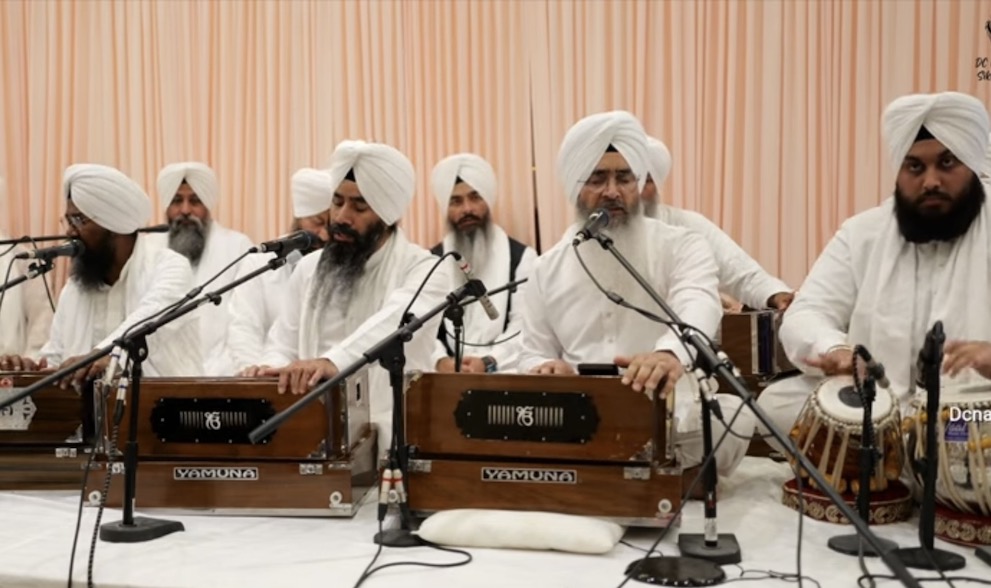
Kirtan is the singing of Gurbani — the sacred hymns of the Guru Granth Sahib — and is considered one of the highest forms of devotion in Sikhism. It is performed in every Gurdwara in the world, every day, without exception.
Professional musicians called Ragis perform the hymns using traditional instruments — the harmonium (a hand-pumped keyboard instrument), the tabla (a pair of hand drums), and the traditional sarangi (a bowed string instrument). The congregation sits on the floor and listens, or joins in singing, with heads covered as a mark of respect.
Certain ragas are sung in the early morning, others at sunset, and others late at night. This connection between music, time and devotion gives Kirtan a living, breathing quality that changes through every hour of the day.
SERMON
A sermon or talk, usually based on a theme from Sikh history, comes next. This is followed by the singing of Anand Sahib, a hymn written by Guru Amar Das, the Third Guru.
ARDAS
The congregation then stands with eyes closed facing the Guru Granth Sahib for prayer (Ardas). During the prayer the word Waheguru (Punjabi for ‘praise to the Guru’) is often repeated.
HUKAM
After the prayer, the Guru Granth Sahib is opened at a random page and the hymn found at the top of the left-hand page (Vak or Hukam) is read. The text is considered to be a relevant lesson for the day.
THE CEREMONIAL FOOD: PARSHAD
After the service, food is offered to the congregation. This consists of Parshad and a more substantial meal in the Langar. Parshad is a sweet made from equal quantities of wheat flour, sugar, and clarified butter.
The first five portions are given to Khalsa members in memory of the Panj Pyares (the first five members of the Khalsa). After that parshad is served to everyone without distinctions of rank or caste.
THE FREE FOOD KITCHEN: LANGAR
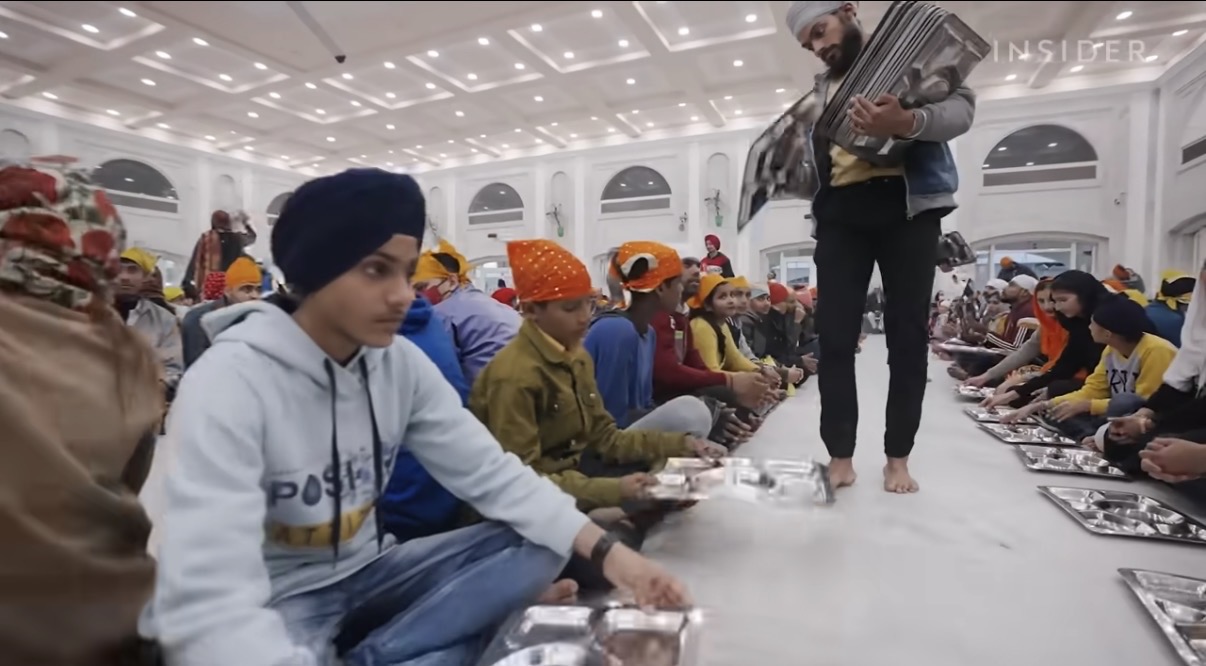
Every Gurdwara has a Langar attached to it where food is served to anyone without charge. The term Langar is also used for the communal meal served at the Gurdwaras.
The food served in the Langar must be simple, so as to prevent wealthy congregations turning it into a feast that shows off their superiority.
Only vegetarian food is served in the Gurdwaras. This ensures that any visitor to the Gurdwara, whatever the dietary restrictions of their faith, can eat in the Langar.
The meal may include chapati, dal (pulses), vegetables and rice pudding. Fish and eggs are counted as meat and excluded
