

Origin Of Sikhism
A Historical & Spiritual OverviewQuick Facts
| Born | 20 October 1469, Talwandi (now Nankana Sahib, Pakistan) |
| Guruship | 1469 – 1539 |
| Key contribution | Founded Sikhism — a faith distinct from Hinduism and Islam |
| Core teaching | Devotion to one God, equality, and righteousness |
| Scripture composed | Japji Sahib, Asa di Var |
| Predecessor | None — First Guru |
| Successor | Guru Angad Dev Ji (2nd Guru) |
| Passed away | 22 September 1539, Kartarpur |
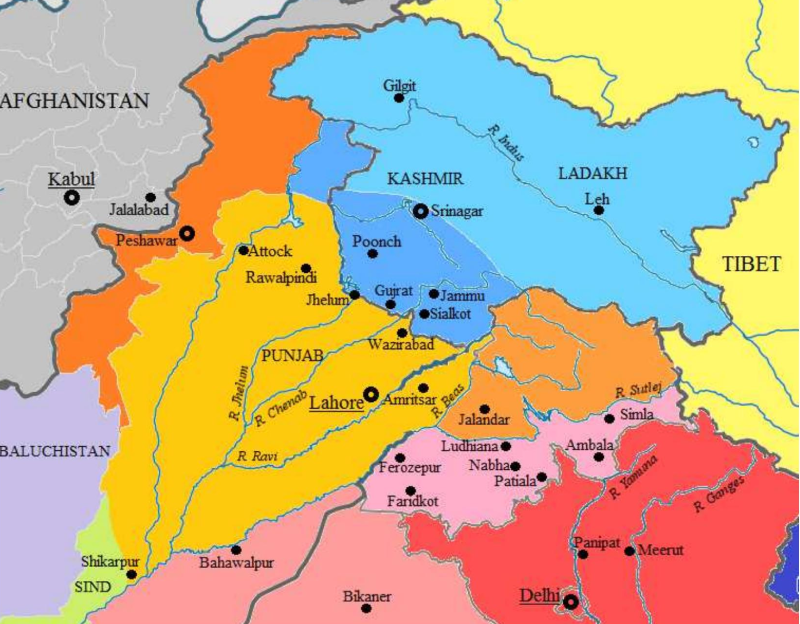
Sikhism emerged in the Punjab region of South Asia — a land that today spans the states of India and Pakistan. At the time, Hinduism and Islam were the dominant religions of the area. Around 1500 CE, Guru Nanak Dev Ji began teaching a faith that was distinct from both. Specifically, he taught a path of devotion to one God, equality, and righteousness — challenging existing religious rituals, the caste system, and the communal divisions of his era. Subsequently, nine Gurus followed Nanak and, over the next two centuries, shaped and strengthened the Sikh faith and community.
“There is neither Hindu nor Mussalman (Muslim), so whose path shall I follow? I shall follow God’s path.
God is neither Hindu nor Mussalman, and the path which I follow is God’s.”
MILITARIZATION OF THE SIKHS
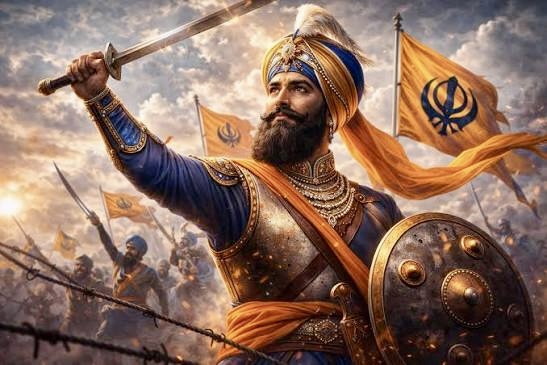
By the time of Guru Arjan — the fifth Guru — Sikhism had firmly taken root. Guru Arjan established Amritsar as the spiritual capital of the Sikh world and compiled the first authorised book of Sikh scripture, the Adi Granth. However, the Mughal state viewed Sikhism as a threat, and in 1606, authorities executed Guru Arjan for his faith.
In response, the sixth Guru, Hargobind, began to militarise the community so they could resist oppression. They fought a number of battles to preserve their faith. For a time, the Sikhs lived in relative peace with the political rulers. However, that peace ended with the Mughal Emperor Aurangzeb, who used force to compel his subjects to accept Islam. In 1675, Aurangzeb ordered the arrest and execution of the ninth Guru, Tegh Bahadur.
THE KHALSA
In 1699, the Tenth Guru, Gobind Singh, transformed the Sikhs into a military order of men and women — the Khalsa — with the intention that they should forever be able to defend their faith. Furthermore, Guru Gobind Singh established the Sikh rite of initiation (Khandey Di Pahul) and the Five Ks, which give Sikhs their distinctive appearance. As the last human Guru, he declared that Sikhs should henceforth treat their scriptures — the Guru Granth Sahib — as their living Guru.
AFTER THE GURUS
The first military leader to follow the Gurus was Banda Singh Bahadur. He led a successful campaign against the Mughals until the Mughals captured and executed him in 1716. Nevertheless, the Sikhs rose up again in the mid-18th century and, over the next 50 years, steadily expanded their territory. In 1799, Ranjit Singh captured Lahore, and by 1801 had established Punjab as an independent state with himself as Maharaja. He proved an able ruler of a state where Sikhs remained a minority. Although deeply devout, he participated in religious ceremonies alongside Muslims and Hindus alike.
DEFEATED BY THE BRITISH
After Ranjit Singh died in 1839, the Sikh state crumbled under the weight of vicious internal power struggles. By 1845–46, British Empire troops had defeated the Sikh armies and seized much of their territory. The Sikhs mounted another rebellion in 1849 — however, the British crushed it decisively, ending Sikh political independence.
SIKHS AND THE BRITISH RAJ
After this final defeat, Sikhs and the British discovered unexpected common ground and built a strong relationship. A lasting tradition of Sikhs serving with great distinction in the British Army began during this period. Part of the reason relations worked well was that Sikhs came to see themselves as partners of the British rather than mere subjects of the Raj. However, the British also manipulated the situation — taking control of the Sikh religious establishment by placing their own appointees in charge of the Gurdwaras. Ultimately, this goodwill collapsed in 1919 with the tragedy of the Amritsar Massacre.
1919 – THE AMRITSAR MASSACRE
This stands as one of the most shameful events in the history of British India. In April 1919, British troops under General E. H. Dyer opened fire without warning on 10,000 people gathered for a peaceful protest meeting. Approximately 400 people died and 1,000 suffered wounds. Dyer claimed he acted to teach Punjab a moral lesson. When the British government recognised the catastrophic damage this caused, they forced Dyer into retirement — although not before promoting him.
Many historians regard the Amritsar Massacre as a turning point that accelerated the decline of the British Raj, as it dramatically strengthened the movement for Indian independence. In October 1997, Queen Elizabeth II visited the site and laid a wreath in a gesture of acknowledgement.
THE PARTITION OF INDIA
When British India gained independence in 1947, the country split between India and the newly formed Islamic state of Pakistan. The Sikhs felt deeply wronged by this arrangement and reluctantly chose to align with India. They could not realistically demand a state of their own — too few in number to resist Pakistan's claim to the Punjab. By siding with India, they managed to retain part of the Punjab, though not before suffering appalling loss of life in communal massacres. As a result, Sikhs lost many of their privileges and much of their land, leaving them deeply discontented.
A STATE OF THEIR OWN
India refused to concede the Sikh ambition for an independent state, fearing that doing so would give communalism — religious groupings in politics — an unbreakable foothold in a country meant to be secular. Nevertheless, in 1966, after years of persistent Sikh demands, India divided the Punjab into three parts, creating a new Punjab with a Sikh majority. Even this move failed to satisfy Sikh anger. Many Sikhs saw the new boundaries as deliberately unfair and a continuation of oppression. Consequently, they pressed the Indian government for further concessions
THE INVASION OF THE GOLDEN TEMPLE
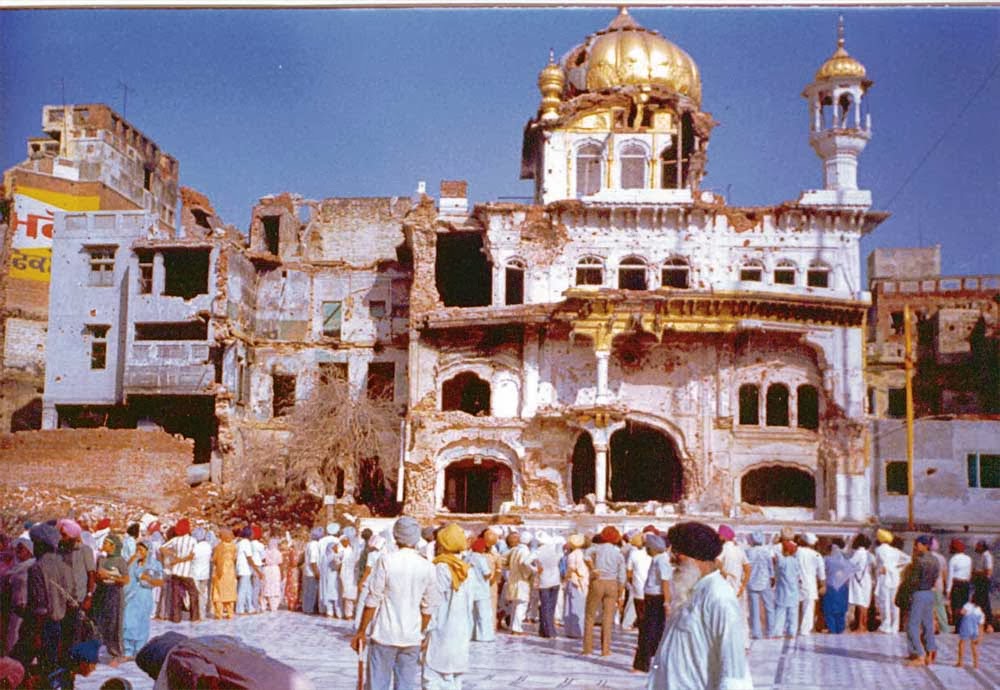
As Sikh discontent deepened, the conflict gradually shifted from a political dispute into a direct confrontation between Hindus and Sikhs — and eventually into real violence.
A Sikh preacher, Jarnail Singh Bhindranwale, emerged as the leader of the most radicalised faction. The media often portrayed him as speaking for all Sikhs, although in reality he did not. In 1983, Bhindranwale and his closest followers took refuge inside the Golden Temple Complex at Amritsar — the most sacred place in the Sikh world.
In June 1984, Indian troops launched Operation Blue Star. They stormed the Golden Temple Complex, killing many inside and causing serious damage to the sacred buildings. Learn More →
THE ASSASSINATION OF INDIRA GANDHI
TThe invasion of the Sikhs' holiest site enraged many Sikhs — even those with no militant sympathies. They held Indira Gandhi, the Indian Prime Minister who had authorised the assault, directly responsible for persecuting the Sikh faith and community. In October 1984, two of her Sikh bodyguards shot and killed Indira Gandhi. Four days of violent anti-Sikh rioting swept across India in the aftermath. The government reported over 2,700 deaths — mostly Sikhs — while newspapers and human-rights organisations placed the death toll between 10,000 and 17,000.
KEY HISTORICAL TIMELINE
- ~1500 CE Guru Nanak begins teaching the Sikh faith in Punjab
- 1539 Guru Nanak passes away; Guru Angad Dev Ji becomes 2nd Guru
- 1604 Guru Arjan completes the Adi Granth (first Sikh scripture)
- 1606 Guru Arjan executed by Mughal Emperor Jahangir
- 1675 Guru Tegh Bahadur arrested and executed by Aurangzeb
- 1699 Guru Gobind Singh establishes the Khalsa
- 1716 Banda Singh Bahadur captured and executed by Mughals
- 1799 Ranjit Singh captures Lahore
- 1801 Punjab established as an independent Sikh state
- 1839 Ranjit Singh dies; Sikh state begins to crumble
- 1845–1849 Sikh armies defeated by British Empire; territory lost
- 1919 Amritsar Massacre — approximately 400 killed by British troops
- 1947 Partition of India; Punjab divided between India & Pakistan
- 1966 India recreates Punjab as a Sikh-majority state
- 1984 Operation Blue Star; Indira Gandhi assassinated
A FAITH FORGED IN FIRE
The story of Sikhism is the story of a people who refused to be broken. From the divine inspiration of Guru Nanak Dev Ji in 15th century Punjab to the sacrifice of the martyred Gurus, the founding of the Khalsa, the tragedies of Partition and 1984 — the Sikh people have faced every trial with the words of the Guru Granth Sahib in their hearts and the cry of Waheguru Ji Ka Khalsa, Waheguru Ji Ki Fateh on their lips. That faith — tested, proven and unbroken — continues to guide millions of Sikhs around the world today.
Ten Gurus
Meet the ten Gurus who guided Sikhism from 1469 to 1708 — their lives, teachings and lasting legacy.
Read More →The Khalsa
Founded in 1699 by Guru Gobind Singh Ji — the order of initiated Sikhs and the Five Ks explained.
Read More →Guru Granth Sahib
The eternal living Guru — 1,430 pages of sacred scripture, the spiritual authority of all Sikhs.
Read More →Gurbani Audio
Listen to over 2,000 tracks of Gurbani, Katha and Keertan — stream free anytime.
Listen Now →